
This weekend, I went to see Bamiyan, an installation by Jayce Salloum and Khadim Ali at the Royal Ontario Museum. I had been looking forward to seeing this project partly due to seeing strong Salloum work in the past and partly because of the nature of the project, which involved on-the-ground research in Pakistan and Afghanistan. As a result, I included it in an Images Fest roundup for Canadianart.ca, and took note of related press interest as it emerged.
While I found the installation really interesting, I found the institutional aspect of the show interesting as well. A work related to Bamiyan showed at Kelowna's nonprofit Alternator Gallery in 2008, and there cost nothing to view. At the ROM, in contrast, it cost $22 to view as part of general museum admission.
On a more self-critical note, viewers may also likely find this situation interesting from a media angle. When the Kelowna show was on, there was little coverage by supposedly national-coverage Toronto-based media folks like myself. But upon arriving in Toronto, it got this coverage. And Bamiyan isn't the only work this has happened with--when I was talking to Jason McLean last week, he pointed out his surprise at how much media coverage the show "Pulp Fiction" got when it showed at the MOCCA in Toronto following a previous (and largely unnoted) run at Museum London.
In the end, I know that this media dynamic is part of the reason artists and curators aim to show in Toronto--it's a really good way to get "national" media coverage. And the implication on the receiving end is often "well, if the show/artwork any good, it will make its way to Toronto eventually."
Still, I have to say I'm struck by the way that location changes people's access to art, as well as press coverage of same. It's kind of par for the course in a sprawling nation like ours, but it's also kinda unfortunate at the same time.
Image from Lonely Planet
Monday, April 5, 2010
Succumbing to Toronto-pism


Thursday, April 1, 2010
On Trecartin: Yes, I Drank the Kool-Aid, and Dang, was it Tasty! The Art Was Good Too.
The ever-quotable (if not ever-correct) Jerry Saltz has a good saying about buying into art world hype -- I've heard him call it "drinking the Kool-Aid."
Well, when I went to watch five hours of Ryan Trecartin videos at the Power Plant on Saturday -- roughly 7,200 2.5-second scenes, by my estimates -- I was pretty wary about drinking the Kool Aid. I mean Trecartin has received about a bazillion great reviews and awards, which can add up to (a) art world mega success and (b) art world mega suspicion.
In any case, I watched the those five hours of videos and by about a quarter of the way through I myself was a true believer. The Kool-Aid is tasty, and the art is darn good too. I explain a bit of the why in today's NOW:
In his frenetic, absurd videos, Trecartin takes Warhol’s strategies into the Web 3.0 age, using the methods and images of consumer culture to expose same.
Where Warhol used silkscreens and soup cans to prompt a closer look at commercial products (and people as commercial products), Trecartin uses Final Cut Pro and social-media-speak to reveal pressures to package oneself as “sexy” and “successful.”
He also echoes Sherman, using wild makeup, crazy costumes and multiple personas to critique subliminal standards. His CEOs spout nonsensical commercialese (“Go create your own market, you stupid, fucking bitch!”), sport cheap wigs and ride in RVs rather than Town Cars. Comparisons to John Waters, icon of transgressive camp, are also on the money.
Others beg to differ, but I'm staying solid on this one. My only regret is that I had to play the Warhol/Sherman card to make my point. Ah well.

Wednesday, March 31, 2010
Storied Objects: Q&A with Jason McLean
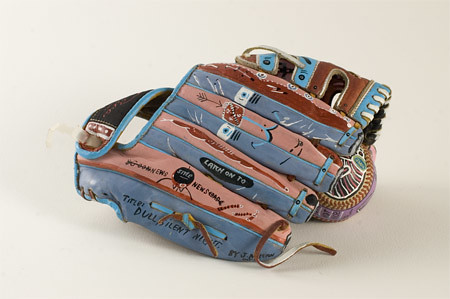
Artist Jason McLean, who recently moved to Toronto after 18 years in Vancouver, has a pretty interesting practice. As I've mentioned here before, he works in drawing as well as sculpture and multiples. Particularly striking are his reworkings of sports equipment, such as those seen above.
Since McLean is having a show at Jessica Bradley in Toronto right now, it seemed an opportune time to sit down and have a chat. Today, a condensed version of same was published in the National Post. Here's an excerpt:
Q Often you paint on old photographs or used sports equipment. Why?
A Sometimes I enjoy the awkwardness between sports and art. I'ma closet sports fan, and I like the way a recognizable object opens up to a larger audience.
The photos partly started when I worked for Adbusters. They wanted me to work over 40or 50 pharmaceutical photos. Book art by people like Marc Bell influenced me, too.
But sometimes, there's so much age in an object you can't go wrong working with it! It's kind of like an older person who has all sorts of stories. It's so much more interesting than someone new, in a way.
...
Q In addition to making art, you collect it. Why?
A It's like an addiction, I guess. In my early years, I liked to collect sporting cards, trading them and getting deals.
Art collecting is sometimes about remembering people when you leave a city. Sometimes it's about wanting to make a home feel different. Sometimes people inspire you, so if you can acquire something of theirs, it seems magical.
I'm really into trading art, too. We've traded art for wholesale fruit, birthing doulas, house tiling and law work. It's like, what can't you trade? I've never traded for a car, but then again, I don't drive.
Image of one of McLean's works (not in the Bradley show) from StyleServer
Tuesday, March 30, 2010
Arts Journalism Panel (Slash Prairie Dog Meetup?) April 20
Over the past few days, many art bloggers have been giving the New Museum's Richard Flood a lot of rightful flack for his comments on bloggers being prairie dogs. (To be clear, he hoped for a negative association on this comparison, though I must say I kind of like prairie dogs--that's what you get for spending developmental years in the same province as the Torrington Gopher Hole Museum.)
It seems that some related themes might be raised--albeit more subtly--in the Canadian Journalism Foundation's upcoming panel, "Arts Journalism: Staying Critical in the Digital Age," which takes place April 20 at Innis Town Hall in Toronto.
According to the event's press info,
From the cultural giants of the past to the celebrity culture of today, how arts criticism and literary journalism have changed. Mainstream media cutbacks and the proliferation of blogging means everyone is a critic. Can the web save arts journalism? A CJF Forum moderated by Bronwyn Drainie, Editor of the Literary Review of Canada, and featuring Kamal Al-Solaylee, Assistant Professor at Ryerson and former theatre critic at the Globe and Mail, Seamus O'Regan, co-host of CTV's Canada AM and host of Arts & Minds and The O'Regan Files on Bravo!, and Globe and Mail columnist and feature writer Kate Taylor, currently on leave as the Atkinson Fellow for 2009-2010.
Though I'm looking forward to attending this event--panels on arts journalism (not just art criticism) are few and far between in these parts--I must note that despite the setup's reference to blogging, no one on this panel is a blogger, nor seems to work heavily on the interwebs. Ah well. At least Kate Taylor has been studying "Canadian cultural sovereignty in the digital age" for her Atkinson Fellowship, and Seamus O'Regan seems to have a Twitter account. It will be interesting to see what discussion is generated.
Image of "The Train to Gopherville is Coming" from jky.net

Saturday, March 27, 2010
Out today: Queen West Reviews of Rasmussen, Building Storeys & Micah Adams
While posters for Art Condominiums plaster Queen West these days, actual art can seem harder to find. (Greener Pastures Gallery is now a hair salon, for instance.) But there's still a few good shows out there, as I point out in today's National Post gallery column. Here's an excerpt:
Elise Rasmussen at Katharine Mulherin, 1082 Queen St. W.
Toronto-trained, Brooklyn-based artist Elise Rasmussen offers an alternately dreamy and dismal look at Newfoundland in this compact solo show. Revving up the romanticism are four large photos of windswept landscapes and lasses looking out to sea. Bringing the despair is a small-town mural of a bustling Main Street shown right next to the actual ultra-deserted strip. These extremes intertwine in other works, like After Shanawdithit, which photographs 30 Newfoundland women posing the same way the last known Beothuk did in a famed painting. A double-frame video, titled When the Sun Crosses the Line that Wind Will Rule the Weather, reinforces the effect, presenting shots of quaint fishermen and sunny forests alongside a voice-over on cultural extinction. First, Rasmussen seems to suggest, the Beothuk were driven to their deaths. Since then, the way of life that drove them out -- the colonial fishery -- has met dire straits, too. There's no resolution, and no masterpieces, but certainly evocative and considered stuff. Overall, Rasmussen's show represents a thoughtful attempt to get inside a place and its difficult complexities. To March 28.
Besides my other picks in the paper at the Gladstone and Queenspecific, I recommend Dorian Fitzgerald's show at Clint Roenisch--though I admit I'm a bit biased, having known Fitzgerald socially for a couple of years. Will Munro's show at Paul Petro, which closes this weekend, is also worth a stop by.
Image of Elise Rasmussen's Zephyr of the Bay from her website

Friday, March 26, 2010
Mailbag: Was my Sullivan Review Justified?
At the Bring It panel in December, I urged people who had concerns about art coverage in any publication to write a letter to the editor. Without reader feedback, editors, publishers and writers have little indication that art coverage is being read, let alone engaged with.
So I'm appreciative of the following letter that appeared in this week's NOW, referring to my March 4 Francoise Sullivan review:
Sullivan overlooked
Leah Sandals’s research on the Françoise Sullivan exhibition at the AGO (NOW, March 4-10) somehow managed to completely overlook the dance performance of Sullivan’s work at Walker Court.
This performance was well advertised and put on in partnership with Women’s Art Resource Centre, where there is currently an exhibition of Sullivan’s most recent paintings.
I curated this show. NOW had a listing in the must-see shows for the opening. So this begs me to ask: do your art critics look at their own magazine while doing research for their reviews?
Natalie Olanick
Montreal
I'm heartened by this letter because Olanick clearly cares about Francoise Sullivan's art and how it is represented--something I care about too. She's also willing to put her point of view out there, and I appreciate the time and effort it took to do that.
Looking over my review for how I might have contributed to Olanick's dismay, I see I could've summarized my main point more clearly, rather than just implying it. That point would be: while Sullivan's legacy is indeed long and admirable, the AGO failed to do it justice in this show.
However, that poor writing decision aside, I still stand by my original 2-N review. Here's why:
First, I was genuinely disappointed by this AGO show.
When I first learned the gallery was planning a Sullivan exhibition, I was excited. Sullivan is an influential, prolific and longstanding Canadian artist, so I was anticipating that a museum show pitched as a celebration of her career would demonstrate that legacy to the public by (a) being of significant/appropriate installation size, (b) including work from a variety of eras, particularly historical ones and (c) perhaps even including work by a few of the many artists she had influenced.
As a result, I was crestfallen to visit the show and see just one smallish room allotted, exhibiting works from just two points in Sullivan's long and varied career. Sullivan deserves much better than this as a major-museum celebration of her successes, as do visitors.
Second, in a brief, current-show review, the writer's main obligation is to assess a months-long exhibition as most members of the public might actually see it (ie. sans one-night performance) and let them know whether the exhibition is worth their time and money (which in this case would involve forking over an $18 admission fee).
In this type of short article, it is not the reviewer's job to include information about related events (particularly long-past ones, like the single February 10 performance) and thematically akin shows which the exhibition itself doesn't bother to reference. In an interview, feature or long, post-show review, sure, these other types of events or shows might be up for inclusion. But they're far from compulsory in a briefer, more user-oriented context.
Third, it is crucial for a vital criticism that writers review not just artists but exhibitions. Again, we can all agree that Sullivan is a terrific artist. But did this show deliver on what it promised? A museum-level celebration of a career? Hell, no. It was like paying for a Springsteen tribute concert and getting just two or three songs performed. Or ordering a hardcover Atwood biography only to discover, when the order is delivered, that it's a 16-page leaflet.
This said, Olanick's letter did prompt a few questions that were new and relevant to me: why didn't the AGO make footage from the February 10 Sullivan performance available to exhibition visitors? In the age of digital video, it seems like this is would be somewhat doable, and extend the benefit of these types of one-night events over a run of several months.
Also, why didn't the AGO refer visitors to the concurrent WARC exhibition? Or at least provide a couple of perfunctory reference texts in the exhibition space for people who wanted to find out more? If Olanick is concerned about how the public is going to experience Sullivan through this exhibition, I urge her to craft another cogent letter—this one addressed to 317 Dundas Street West.
Image from Cartoonists with Attitude

Thursday, March 25, 2010
Critical Canvas: Q&A with Lawrence Paul Yuxweluptun
When I was visiting the National Gallery last year, I really enjoyed a few works I saw by Lawrence Paul Yuxweluptun--they seemed at once to be abstract and politically pointed. (I'm thinking here of Tweaker, a beautiful abstract-seeming painting that also refers to drug addiction and First Nations issues.) Looking at his work later online, I also really enjoyed how he took First-Nations symbols and turned them, kind of conversely, into "real-world" figures. (The image above, New Chiefs on the Land, is a good example of this stream of his work.)
So when I heard Yuxweluptun was having two concurrent shows in Vancouver--one at dealer Buschlen Mowatt and one at the nonprofit Contemporary Art Gallery--I thought it would be a great chance to chat with him. The resulting Q&A is out in today's National Post. Here's an excerpt:
Q Other paintings of yours can seem quite abstract. How do those relate to your concerns?
A Well, we can look at land claims in an abstract way. How much money do you want to settle this land? OK, well, then, what price do I put on a rainbow that touches my land? Maybe I have to look at every raindrop that created the rainbow. And then I have to look at every cloud that creates the raindrop. And so on.
Basically, I'm working to look at all these things, and to create a style that translates one culture into another culture so others can see it. I'm an artist, so I think that's in my job description--I'm responsible for looking at life, whether it's a tree in the forest or the fact that Frank Paul was dragged out to die in the rain.
Q What else do you make paintings for?
A Well, for all these heavy things I've talked about, I do enjoy creating them. Art can be a lot of fun, a way of helping others. I've worked for over 30 years to develop my style. In the past, I made a lot of black and white drawings because I wasn't sure I was skilled enough to paint those same images. Sometimes it's taken 20 years between the initial drawing and the final painting.
The hardest artwork I ever did was about two Indian heroin addicts. I sat there and drank my beer while they shot up. And there was no totem pole. There was no framework that would allow me to deal with that cultural context. I had to look at it in a different form--instead of a physical, humanoid image, I took it to a symbolic level.
Overall, I think what comes out in my work is the lived experience instead of the gaze, or the lived experience instead of somebody else's gaze.
The artist also has work in the Vancouver Art Gallery's group show Landscape Manual, and the group show on abstraction in First Nations art at the National Gallery continues to April 2010.
Image of Yuxweluptun's New Chiefs on the Land from Guestlife.com

